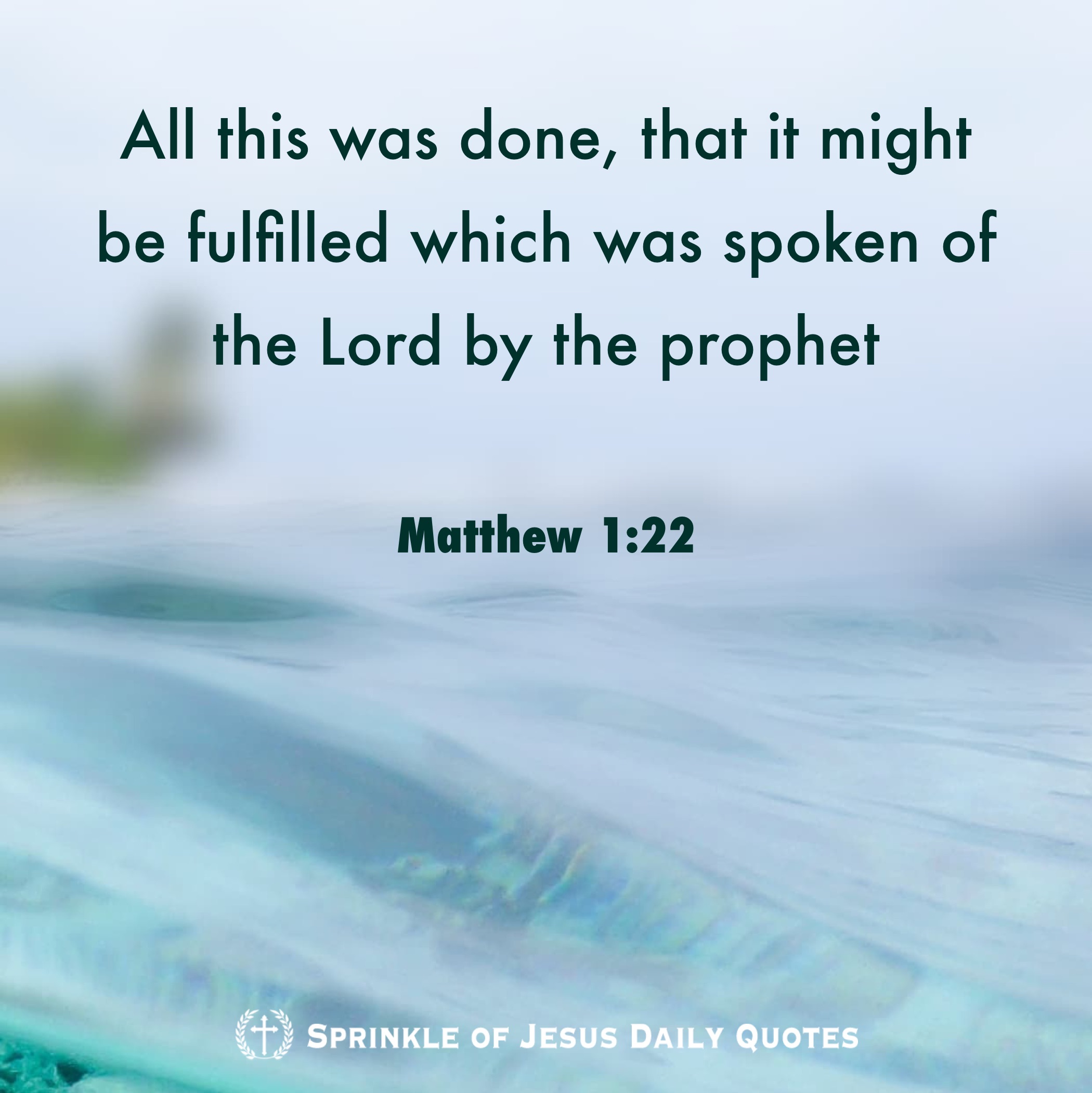
That a virgin would bring forth a son is astounding; that Jesus will certainly save his people is reassuring; that God would condescend to be with us is humbling. But there is another point that Matthew purposefully interjects into the inspired account of Jesus’ birth, and it is this: “all this was done, that it might be fulfilled.”
When you think of Biblical prophecy, do you think of God describing events that will later come to pass, or of God declaring that events will later come to pass? In other words, is prophecy simply God “looking down through the tunnel of time,” seeing what is going to happen, and reporting what he sees? Or is prophecy the declaration of God, based upon his almighty power and wisdom, of what he has foreordained to happen?
If we speculated that prophecy is merely description based on foresight, then we would expect Matthew to say something like this: “so God had spoken all these things by the prophet because they were going to happen later.” But Matthew actually says the opposite! “All this was done, that it might be fulfilled…” All these things happened, Matthew says, because God said they were going to happen!
From Matthew’s careful wording in this story, we learn that God’s word is more certain, more secure, more immovable than any event on earth. Reality itself must conform to the perfect purpose and plan of God. And this choice of words by Matthew is no mistake or anomaly. Matthew uses the exact same phrase — “that it might be fulfilled” — no less than ten times throughout his gospel!
Clearly, Matthew intends for us to see God’s omnipotence shaping reality with his Word. Is that the way you view the world around you today?
How To: Zondervan Illustrated Collection
The Zondervan Illustrated Collection combines three of the best individual Bible study titles together in one collection. This post will walk you through how to use these three resources to get more out of your Bible study. Here’s what’s included in the package:
The Zondervan Atlas of the Bible
The Zondervan Bible Commentary
The Zondervan Illustrated Bible Dictionary
Though these three volumes are available individually, by far the best deal is to purchase the collection. Let’s take a look at how these three volumes work seamlessly in the Olive Tree app. The Scripture we’ll be studying is John’s first vision in Revelation.An Exilic Vision
After a brief introduction and greeting in verses 1-8, John describes the circumstances surrounding the vision he received of Christ in Revelation 1:9. “I, John, your brother and companion in the suffering and kingdom and patient endurance that are ours in Jesus, was on the island of Patmos because of the word of God and the testimony of Jesus.”
With this verse open in the main window, the Resource Guide shows two notes from the Zondervan Bible Commentary.
Tap on the resource and it will show you the larger section of the letter this vision is a part of (1:9-11:19) and the length of the inaugural vision (1:9-20). Tap on “I. The Inaugural Vision” and check out the commentary notes on verse 9.
John describes himself as a fellow companion to his readers in the suffering…kingdom…and patient endurance that they share together in Jesus. Let’s dig in here to find out more about what John is getting at.
Suffering for Jesus
Let’s do a word search on “suffering.” In the Resource Library tap on “Lookup.”
Type suffering in the Search Bar and survey the results that will auto-populate. There are ninety references to suffering in the Zondervan Illustrated Bible Dictionary.
Instead of surveying each of those references, let’s look for an article on suffering instead. Scroll until you see the “Articles” heading and tap on Zondervan Illustrated Bible Dictionary.
Two separate articles are shown for the word suffering: persecution and tribulation. Tap on tribulation.
Now you can read all about tribulation and the following article on the great tribulation. There are several references to the tribulation in Revelation (Rev. 2:22; 7:14; cf. 6-19). The article doesn’t list verse 9, but it does give us a general reference to what John refers to. He was fellow companion in the suffering being experienced by all the other brothers at that time.
On Patmos
Another interesting feature of this opening verse to John’s vision is that he actually gives his location. He is “on the island of Patmos.” Since this is not as well-known as other places in the NT, this is where the Zondervan Atlas of the Bible comes in handy. We can search for Patmos just like we searched for tribulation.
If you tap on the first reference, you’ll see a picture of Patmos. Tap on the picture to see it open in the entire window. Doesn’t look like a very luxurious place! I can see why John referred to his time there as suffering for Jesus!
Or we can go back to the Resource Guide and scroll down to the Maps section. Here, we’ll find the maps available in our Library. John identifies the recipients of his letter by name. Let’s tap on the map that will show the location of Patmos and the seven churches in Revelation. Here we see the location of Patmos in relation to the churches that would receive this letter.
The Seven Churches
There is a great article in the Zondervan Atlas of the Bible on the seven churches in Revelation. Each of the seven cities where the churches are located are described in great historical detail. A remarkable photo of a stunning open-air amphitheater is included in the section on Pergamum.
Go Deeper With This Collection
If you liked what you read here, then check out the Zondervan Illustrated Collection (3 Vols.) in our store!

Great Savings: Zondervan Atlas of the Bible
The maps and charts at the back of your Bible provide just a taste of how illustrated study aids can bring your Bible reading to life. Imagine the impact of a product chock full of interesting and helpful illustrations about the land and culture of the Bible story! The Zondervan Atlas of the Bible is the perfect product to make the pages of the Bible come alive with understanding and context.
Laid out for easy access to the information, the product opens with a broad focus on the Middle East as a whole, featuring discussions on the geography of the area and narrowing to a particular focus on Israel and Jordan.
The second section follows a historical timeline beginning in the third millennium BC and working through the fall of Jerusalem in AD 70. Divided out into significant eras, it provides a guide that will allow you to understand more deeply how the land, culture and geography affected the Israelites, with both biblical and extra biblical sources tapped.
The final section provides several appendices, including a geographical dictionary and index. Looking up a location in this index can give you quick one-tap access to the related material in the atlas.
Great Savings!
Zondervan Atlas of the Bible
Spaghetti and Meatballs With Marinara Sauce
What’s the most delicious thing you’ve ever eaten?
I love Spaghetti. It is one of my favorite dishes that I fix often. I make this dish where I work and they love it. The thought of eating my favorite dish makes me happy. It is so delicious! It’s quick to make depending on the kind of spaghetti strings you’re using. I like the angel hair pasta strings, they cook quick. I like how they take in the sauce all of the way and not just partly. This dish is delicious because it reminds me of my childhood learning to make it differently instead of the same way all of the time. Now that I am grown, I have more ideas for this dish. The possibilities are endless but I will keep them to myself for now. I have to try them out before I share them. What’s the most delicious thing you have ever eaten? Until next time, keep being creative in the kitchen.
Motivation for Today: 6/29/23
If you want to change what you feel, you’ll have to change what you’re focusing on.
From the Motivation app: https://motivation.app/download
Self-Love Motivation for 6/29/23 Thursday
Forgive yourself for all of the times where you chose yourself last.
From the Motivation app: https://motivation.app/download
A Living Hope in a Better Inheritance
It is very easy in our day and age to find ourselves fascinated with anything new. It could be a new TV show, a new gadget, a new pet, or a new restaurant. With new things popping up everywhere, it is ever so easy to overlook or forget about the old.
This is also the case in the church. Pastors and elders must fight against the temptation of novelty for novelty’s sake. One of the things that makes the fight easier is by remembering the past. The Ancient Christian Commentary on Scripture is a resource that makes the old accessible. For those who live under the tyranny of the novel, this is a breath of fresh air.
The Ancient Christian Commentary on Scripture series spans roughly the first thousand years of church history, from Clement of Rome (regn. 92–101?) to Theophylact of Ohrid (c. 1050-c. 1108). This series provides comments on Scripture from a multitude of church fathers from the pre-Reformation era. They ground their exegesis in the Scriptures and inform it through the developing tradition of the church, as well as their own experiences. Here are some of their comments on 1 Peter 1:3–9.
The Living Hope of those Who Have Been Born Again
“Blessed be the God and Father of our Lord Jesus Christ, who according to His abundant mercy has begotten us again to a living hope through the resurrection of Jesus Christ from the dead, to an inheritance incorruptible and undefiled and that does not fade away, reserved in heaven for you, who are kept by the power of God through faith for salvation ready to be revealed in the last time. In this you greatly rejoice, though now for a little while, if need be, you have been grieved by various trials, that the genuineness of your faith, being much more precious than gold that perishes, though it is tested by fire, may be found to praise, honor, and glory at the revelation of Jesus Christ, whom having not seen you love. Though now you do not see Him, yet believing, you rejoice with joy inexpressible and full of glory, receiving the end of your faith—the salvation of your souls.” -1 Peter 1:3-9
When God is the Giver
Andreas on 1 Peter 1:3
Andreas (c. seventh century) was a monk who collected commentary from earlier writers to form a catena on various biblical books.
“They have received immortality and the hope of eternal life. These good things in heaven are better than human things. For this reason they praise God the Father, who shows his great mercy in doing these things faithfully. When God is the giver, the things given are both better and certain to materialize. The statement also has relevance to the Old Testament, for in it God gave the land of the Canaanites to those who believed in him.”
His Mercy is Great Enough
Hilary of Arles on 1 Peter 1:3
Hilary (c. 401–449) was the Archbishop of Arles and leader of the Semi-Pelagian party. Hilary incurred the wrath of Pope Leo I when he removed a bishop from his see and appointed a new bishop. Leo demoted Arles from a metropolitan see to a bishopric to assert papal power over the church in Gaul.
“Peter means that God has acted to redeem us without any help from us. His mercy is great enough to be able to forgive every sin which has been committed in thought, word and deed, from the beginning to the end of the world.”
The Inheritance God Gives
Oecumenius on 1 Peter 1:3
Oecumenius (sixth century) was called the Rhetor or the Philosopher. Oecumenius wrote the earliest extant Greek commentary on Revelation. Scholia by Oecumenius on some of John Chrysostom’s commentaries on the Pauline Epistles are still extant.
“What exactly are the blessings which God has given us in Christ? First, there is hope, not the kind of hope which he gave to Moses, that the people would inherit a promised land in Canaan, for that hope was temporal and corruptible. Rather God gives us a living hope, which has come from the resurrection of Christ. Because of that, he has given all those who believe in Jesus the same resurrection. This is a living hope and an incorruptible inheritance, not stored up here on earth but in heaven, which is much greater.”
Rising With Him
Bede on 1 Peter 1:4
The Venerable Bede (c. 672/673–735) was born in Northumbria, at the age of seven he was put under the care of the Benedictine monks of Saints Peter and Paul at Jarrow and given a broad classical education in the monastic tradition. Considered one of the most learned men of his age, he is the author of An Ecclesiastical History of the English People.
“Peter offers praise to God the Father in such a way as to make it perfectly clear that our Lord and Savior is both God and man. He calls God the Father of our Lord precisely because he does not doubt that our Lord had always existed with him as his Son. It is right for us to bless God because although on the strength of our own merits we deserve nothing but death, he has regenerated us by his mercy to a new life. He has done this by the resurrection of his Son who loved our life so much that he gave himself up to death for our sake. When he overcame that death by his resurrection, he offered it to us as a model which might give us hope of rising again ourselves.”
An Inheritance Unfading
Didymus the Blind on 1 Peter 1:4
Didymus the Blind (c. 313–398) was an Alexandrian exegete who was much influenced by Origen and admired by Jerome.
“In order to show how the inheritance of the blessed will continue forever, Peter calls it incorruptible and unfading. He demonstrates by this that it is a pure and divine inheritance which will remain uncontaminated in the eyes of those who care nothing for their present wealth. They know that they have something better and eternal waiting for them.”
The Saints Shine Like Refined Gold
Athanasius on 1 Peter 1:7
Athanasius (c. 295–373; fl. 325–373) was Bishop of Alexandria from 328, though often in exile. He wrote his classic polemics against the Arians while most of the eastern bishops were against him.
“Because the saints saw that the divine fire would cleanse them and benefit them, they did not shrink back from or get discouraged by the trials which they faced. What they went through did not hurt them. Instead, they grew refined, shining like gold that has been refined in a fire.”
Not All Suffer Now
Chrysostom on 1 Peter 1:7
John Chrysostom (344/354–407; fl. 386–407) was Bishop of Constantinople who stood out for his orthodoxy, his eloquence and his attacks on Christian laxity in high places.
“The righteous suffer so that they may be crowned with glory, but sinners suffer in order to bring judgment on their sins. But not all sinners pay the price of their sins in this life, but await the resurrection. And not all the righteous suffer now, lest you think to praise evil and you come to hate the good.”
Made Incorruptible by Grace
Clement of Alexandria on 1 Peter 1:9
Clement of Alexandria (c. 150–215) was a highly educated Christian convert from paganism, head of the catechetical school in Alexandria and pioneer of Christian scholarship. His major works, Protrepticus, Paedagogus and the Stromata, bring Christian doctrine face to face with the ideas and achievements of his time.
“It appears from this that the soul is not naturally incorruptible but is made so by the grace of God, through faith, righteousness and understanding.”
Go Deeper!
These comments were just several of nearly thirty from these few verses. This commentary series includes headings and overviews for each pericope in Scripture, along with the comments from the church fathers. Escape the unceasing cycle of novelty by reading and learning from those who have gone before us.
Get a copy of the New Testament series, or the full series below:
Ancient Christian Commentary on Scripture: New Testament (14 Vols.)
Ancient Christian Commentary on Scripture (29 Vols.)

Someone Who Loves You: Self-Love
Someone who loves you will fall in love with every version of you. Happy, sad, angry, funny, sassy. They love all of them because they love all of you.
From the Motivation app: https://motivation.app/download

www.olivetree.com/votd/index.php

The Zondervan Illustrated Collection combines three of the best individual Bible study titles together in one collection. This post will walk you through how to use these three resources to get more out of your Bible study. Here’s what’s included in the package:
Zondervan Atlas of the Bible


If you want to change what you feel, you’ll have to change what you’re focusing on.
Forgive yourself for all of the times where you chose yourself last.

www.olivetree.com/votd/index.php


It is very easy in our day and age to find ourselves fascinated with anything new. It could be a new TV show, a new gadget, a new pet, or a new restaurant. With new things popping up everywhere, it is ever so easy to overlook or forget about the old.


Someone who loves you will fall in love with every version of you. Happy, sad, angry, funny, sassy. They love all of them because they love all of you.