
My Concerns and God’s Concerns: Hebrews 4:16

My site is for uplifting and encouraging those that need spiritual advice and guidance.
Pray for Peace
If we can’t control our circumstances physically, we will fixate on them mentally; our thoughts loop around and around. This is exactly why Paul tells us not to be anxious. He understands the ramifications.
Paul, the author of Philippians, writes: do not be anxious about anything. This is not a suggestion or a recommendation. Reading his warning as optional results in our constant state of fear and we become anxious about everything.
Teaching us how to break the cycle of worry, Paul offers three antidotes:
Prayer. Present your worries to God. Let go of your mental turmoil and trust God’s sovereign power over your circumstances.
Petition. Make an earnest request to the One who has the authority to intervene. His power is strong enough to mend what’s broken in your life.
Praise. Giving thanks protects our hearts. Adoration loosens anxiety’s grip. Thank God for a breathtaking sunset, flowers blooming, snow falling, food to eat, and a warm blanket on a cool day. We can always find something to thank God for.Paul promises God’s peace will guard our hearts and minds in Christ Jesus when we practice prayer, petition, and praise. We won’t be anxious about anything when we go to God with everything. Nothing is too small or insignificant. If it matters to you, it matters to God. He cares about each detail of your life. Let prayer change the way you feel, exchanging worry for peace.


America’s Christian History
SAMPLE
Dr. H. Wayne House
Hello, I’m Dr. Wayne House, author of Olive Tree Software’s America’s Christian History, as well as over 30 other works on law, theology and culture.
Today there is a strong movement to divorce America from its Christian history. Progressive academics and the media have tried to argue that the United States is no longer a Christian nation, if it ever was, and that the Christian faith had little to nothing to do with the founding of our nation. Some Progressives even go so far as to say that the Founders believed essentially as they do — that religion was to be entirely separate from government to the extent that there is to be a “high and impregnable” wall of separation between all things religious and all government — federal down to the local level. Some today even argue that religion is a private matter and unfit to be visible in public society. The First Amendment has been turned on its head, so that it is argued it gives people freedom from religion, rather than freedom of religion. Radical anti-religionists are becoming more and more successful at using the legal system to remove anything religious (and especially Christian) from the public forum.
However, Christianity’s entrenchment in American culture, and even government, seems to give strong evidence against the arguments of the anti-religionists. From our founding documents mentioning the “Creator,” to “In God We Trust” on our coinage, to politicians almost universally ending speeches with “God bless America,” Christianity is such a part of America that the effort to remove it would likely result in the collapse of our nation.
In this book we will further develop the discussion of the current culture war that has developed over the role of religion in our nation and how we got here. We will look at the deep confusion over what the Constitution actually says regarding religion — a confusion that even extends to the highest court in the land.
We will then turn our attention to discovering the truth about the role of religion in forming our country. We will discuss the beliefs and philosophies of those who first settled America. We will show their deep conviction that they were led by God to this new continent, and that some even considered it a kind of new Promised Land. We will discuss the influences on the Founding Fathers’ philosophies, and whether these influences included Christianity. We will show whether the Founders were even Christians at all, or if the bold assertions of many today are correct, namely, that they were no more than Deists. We will examine the Declaration of Independence and the Constitution for evidence of the influence of Christian beliefs.
Next we will discuss topics of religion and government, such as the questions of whether there is a distinction between a Christian nation and a Christian government, whether a “secular state” must also be a godless state, how a Christian view of law and government differs from the views of secularism and paganism and whether a nation can be “under God” but not establish a religion.
We have collected a number of quotes from the writings of several of the Founding Fathers, showing that their religious beliefs refute the claims of the radical Progressives, who are attempting to re-write history.
Finally, we include a list of works for further study of this topic, works that will arm you with the truth about the Christian history of America.
Progressives don’t want you to know the true history of our nation. They are strenuously trying to deny and rewrite history to match their propaganda in an effort to convince us that their system of anti-religious philosophy, rather than Christian beliefs, are the foundation of our nation. At the same time they are seriously attacking those same Christian philosophies from a myriad of directions including education, the political arena and the legal system. This is part and parcel of their effort to reinvent America to make it conform to their radical beliefs. They know that they can only be successful in this endeavor by destroying the very foundations of our country, and they can only destroy the foundations of our country by revising history, so that people become ignorant of actual history. We hope this book will help you understand the true foundational philosophies of our nation so that you will be well informed and able to stand against this concerted effort to transform our nation.
Title
America’s Christian History – Sample


in church history, including Augustine, Martin Luther, Jonathan Edwards, and C. S. Lewis.
The ESV Church History Study Bible is designed to help believers in all seasons of life understand the Bible with notes from over 300 of church history’s most prominent figures.
Edited by Stephen J. Nichols, Gerald Bray, and Keith A. Mathison, this Bible features 20,000+ study notes from historical figures including Athanasius of Alexandria, John Chrysostom, Martin Luther, John Bunyan, Jonathan Edwards, and Charles Spurgeon. This study Bible also includes articles by trusted scholars on major aspects of church history, a glossary of historical figures, and “This Passage in History” callouts. Created for serious readers, students, and teachers of God’s Word, the ESV Church History Study Bible highlights voices from the past offering wisdom for the present.
Features:
• 20,000 Study Notes: Features commentary notes from prominent figures in church history, including Martin Luther, John Bunyan, and Charles Spurgeon
• References for Easier Bible Study: Includes an introduction to each book, a glossary of historical figures, a full concordance, and ecumenical creeds of the church
• In-Depth Scholarship: Features 12 articles about the different phases of church history, the differences in Christian traditions, the history of biblical interpretation, and more
Stephen J. Nichols (PhD, Westminster Theological Seminary) serves as the president of Reformation Bible College and chief academic officer of Ligonier Ministries. He has written over twenty books and is an editor of the Theologians on the Christian Life series. He also hosts the weekly podcast 5 Minutes in Church History.


The tagline for the new ESV Church History Study Bible is “Voices from the past, wisdom for the present”. Undoubtedly, we are in dire need of wisdom today, but do we turn to church history for that wisdom? The ESV Church History Study Bible seeks to correct that. This new resource shows us the rich history we are neglecting to our own detriment. Read on to learn more about this unique resource that helps bridge the gap between the past and the present.
“The ESV Church History Study Bible is intended to serve pastors and students, placing a wealth of teaching, insight, and encouragement from church history alongside the biblical text…[it] is also intended to serve laity by introducing them to the vast riches of church history that can encourage and edify. Finally, [it] stands as a reminder to all of us that we are part of one body, proclaiming one gospel, reading and studying one Bible, in obedience and service to one Lord and Savior” – Stephen J. Nichols, Introduction
We want to show you how the ESV Church History Study Bible (ESV CHSB) distills and features the wisdom of the past. Let’s look first at book introductions.
BOOK INTRODUCTIONS
The first way this resource distills and features the wisdom of the past is in the introductory material to each book of the Bible. These are no ordinary introductions though. These introductions highlight the history of interpretation of these books or historical issues regarding these books. Check out this introduction that highlights the impact Galatians had on Martin Luther and the Protestant Reformation.

SCRIPTURE NOTES
The bulk of the wisdom from the past in the ESV CHSBis in the Scripture notes. These notes, over 20,000 of them, include authors from every century of church history. The author and the source containing the note are provided demonstrating our rich heritage.

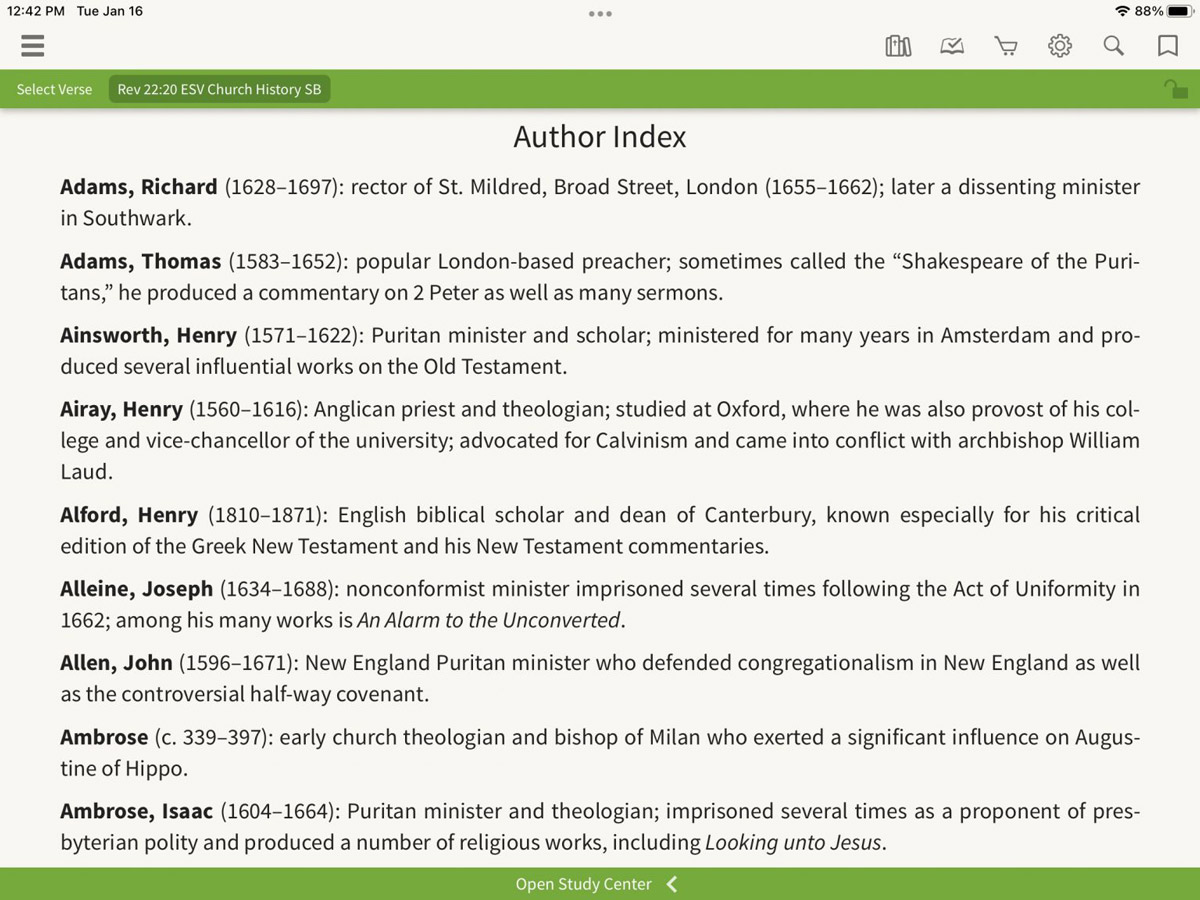
An index in the end matter shares a short biographical sketch of each author used in the study Bible.
ARTICLES
An additional feature of the ESV CHSB is a collection of 12 articles in the end matter. Contemporary scholars wrote these articles on different topics related to church history. These topics range from the History of Biblical Preaching to Creeds and Confession to the Bible and the Global Church.

“If you have any regard to the constancy of your faith, to the comfort of your life, the honor of God, or the salvation of your own soul, labor immediately to get your belief of the Word better founded. Read the Scripture constantly, study it seriously, search it diligently, hear it explained and applied by others, meditate on it yourself, and beg of God an understanding of it and a right faith in it.” – John Owen
What a treasure trove! The ESV Church History Study Bible is excellent for reading the Word of God alongside the voices of the past. Visit our store today and get wisdom from the rich history of the church!


 bible.com/bible/1/php.4.6-7.KJV


 www.olivetree.com/votd/index.php


 Food for the Soul