
Welcome to: Guided Prayer

My site is for uplifting and encouraging those that need spiritual advice and guidance.
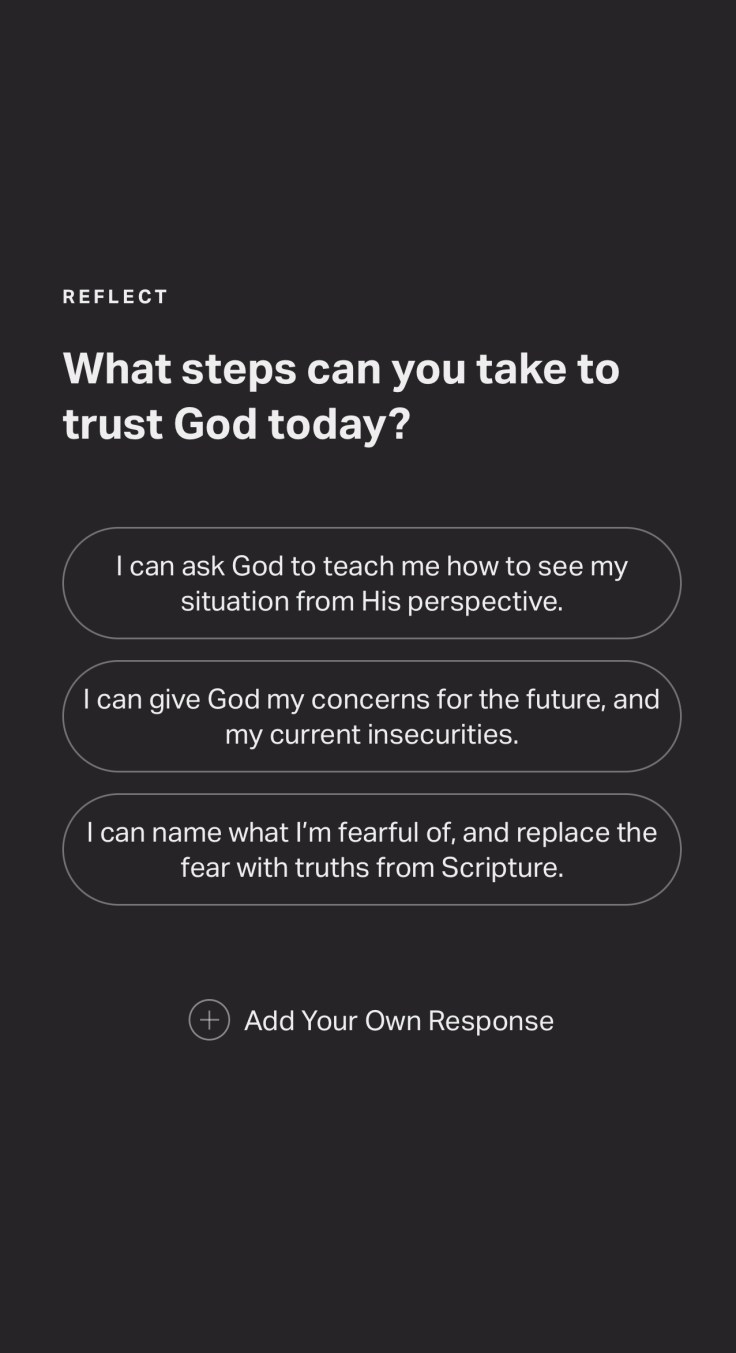
How to fight fear
Think back to a time when you were genuinely scared.
As much as we’d prefer to never experience fear, fear is a part of the human experience. But when we are afraid, we have options…
We can panic, stress, get overwhelmed with worry, overthink every worst-case scenario, and attempt to numb out the anxiety-inducing situations around us in unhealthy ways … or, we can echo David’s words:
“When I am afraid, I put my trust in you.”
Psalm 56:3 ESVSomething worth noting is that these words were penned after David had been captured by the Philistines. He was being harassed by his enemies and was scared for his life.
But David refused to settle for scared.
He resisted the urge to let fear have the final say. He decided to fight back with Truth…
…And so can we.We never have to fight alone. God has given us something more powerful than ordinary weapons: He’s given us His Word, His Spirit, and His people. Even when we don’t have access to the perfect inspirational sermon or a timely word of encouragement, we can pause and remember the truth: that God fights for us, He’s with us, and He’ll never leave us.
When we shift our minds from our overwhelming fear to God’s overwhelming faithfulness, everything changes. So, today, if you’re scared, anxious, terrified, overwhelmed, or uncertain—speak this out loud:
When I am afraid, I put my trust in You.
How to combat pride
“I’m fine.” “I’ve got this.” “It’s my problem—not yours.”
We all want to be known, but sometimes it feels easier to hide behind masks of self-sufficiency. We might tell ourselves that we don’t want to burden others with our problems, but what we’re really saying is that we believe we can (and should) handle everything alone. This may feel self-protective, but it’s a form of pride that isolates and weakens us.
Pride is simply having a view of ourselves and our abilities that doesn’t align with reality. It’s one of the most effective methods the devil uses to isolate us because it makes us believe we’re better off alone.
So how do we combat it? The apostle Peter advises us to “clothe” ourselves in humility (1 Peter 5:5). We do this by caring for others, watching over others, and accepting the authority and wisdom that others offer us (1 Peter 5:1-4). This requires mutual vulnerability, trust, and authenticity.
Treating others with humility teaches us how to respond to Jesus.
Jesus knows what we need, and God wants us to cast our anxieties onto Him—but giving Him our concerns, hurts, hardships, and heartbreaks is an act of vulnerable surrender. We cannot do this unless we first acknowledge our need for Him.
When Peter says to “cast our cares” on God, he’s telling his readers to come openly and honestly to God so that at the proper time, He can deliver them. God opposes anyone who thinks they don’t need Him, but He shows endless grace and love to those who seek Him (1 Peter 5:5).
So take a few moments right now, and reflect on your current concerns. What do you need to bring to God? Visualize handing Him all of your worries, and envision receiving His peace in return.

Hey! I’m doing a free 15-day New Year Challenge and I’d love for you to join in too. https://gratitude.onelink.me/sQxx/ofz7b068
Click on the link above, or download the Gratitude app to get started.


This content on parallelism and poetry in the Bible is from the Believer’s Bible Commentary.
WHAT IS PARALLELISM?
Bible poetry’s greatest technique is not to rhyme sounds, as in much English poetry, but to “rhyme” ideas—that is, to put two or more lines together that somehow match each other. We should be grateful to God that this is the mainstay of biblical poetry because it translates nicely into nearly all languages and not too much beauty is lost in the translation process. Our Lord Himself also frequently spoke in parallelism. (Carefully reread, e.g., Matthew 5–7 and John 13–17 after studying the following notes.)
We would like to present some examples of the main types of Hebrew parallelism so that you can look for similar structures, not only while studying the OT with the help of the Believer’s Bible Commentary, but also while having daily devotions and listening to sermons.
1. SYNONYMOUS PARALLELISM
As the name implies, this type has the second or parallel line saying about the same thing as the first—for emphasis. Proverbs is especially full of these: “In the way of righteousness is life, and in its pathway there is no death” (Prov. 12:28).
“I am the rose of Sharon, and the lily of the valleys” (Song 2:1).
2. ANTITHETIC PARALLELISM
This type puts two lines “against” each other that form a contrast:
“For the LORD knows the way of the righteous, but the way of the ungodly shall perish” (Ps. 1:6)
“Hatred stirs up strife, but love covers all sins” (Prov. 10:12)
3. FORMAL PARALLELISM
This type is parallel in form only; the two (or more) lines don’t contrast, expand, or emphasize. It is just two lines of poetry put together to express a thought or theme:
“Yet I have set My King on my holy hill of Zion” (Ps. 2:6)
4. SYNTHETIC PARALLELISM
The second line of poetry builds up (synthesis is Greek for “putting together”) the thought in the first line:
“The LORD is my shepherd; I shall not want” (Ps. 23:1)
“Keep your heart with all diligence, for out of it spring the issues of life” (Prov. 4:23)
5. EMBLEMATIC PARALLELISM
A figure of speech in the first line of poetry illustrates the content of the second line: “As the deer pants for the water brooks, so pants my soul for You, O God” (Ps. 42:1)
“As a ring of gold in a swine’s snout, so is a lovely woman who lacks discretion” (Prov. 11:22)
Continue Learning!
Want to learn more about poetry in the Bible (or really, anything in the Bible)? Tap the link below and continue learning!
Believer’s Bible Commentary

The moment you get tired of pushing yourself is the very moment you should push yourself harder.
From the Motivation app: https://motivation.app/download

 bible.com/bible/1/psa.56.3.KJV
 bible.com/bible/1/psa.56.3.KJV


 www.bible.com/en/videos/41670


 bible.com/bible/1/1pe.5.7.KJV


 www.olivetree.com/votd/index.php


 www.olivetree.com/votd/index.php
 bible.com/bible/1/eph.3.16-20.KJV
 Food for the Soul