Verse of the Day: Romans 12:12

My site is for uplifting and encouraging those that need spiritual advice and guidance.

This content on parallelism and poetry in the Bible is from the Believer’s Bible Commentary.
WHAT IS PARALLELISM?
Bible poetry’s greatest technique is not to rhyme sounds, as in much English poetry, but to “rhyme” ideas—that is, to put two or more lines together that somehow match each other. We should be grateful to God that this is the mainstay of biblical poetry because it translates nicely into nearly all languages and not too much beauty is lost in the translation process. Our Lord Himself also frequently spoke in parallelism. (Carefully reread, e.g., Matthew 5–7 and John 13–17 after studying the following notes.)
We would like to present some examples of the main types of Hebrew parallelism so that you can look for similar structures, not only while studying the OT with the help of the Believer’s Bible Commentary, but also while having daily devotions and listening to sermons.
1. SYNONYMOUS PARALLELISM
As the name implies, this type has the second or parallel line saying about the same thing as the first—for emphasis. Proverbs is especially full of these: “In the way of righteousness is life, and in its pathway there is no death” (Prov. 12:28).
“I am the rose of Sharon, and the lily of the valleys” (Song 2:1).
2. ANTITHETIC PARALLELISM
This type puts two lines “against” each other that form a contrast:
“For the LORD knows the way of the righteous, but the way of the ungodly shall perish” (Ps. 1:6)
“Hatred stirs up strife, but love covers all sins” (Prov. 10:12)
3. FORMAL PARALLELISM
This type is parallel in form only; the two (or more) lines don’t contrast, expand, or emphasize. It is just two lines of poetry put together to express a thought or theme:
“Yet I have set My King on my holy hill of Zion” (Ps. 2:6)
4. SYNTHETIC PARALLELISM
The second line of poetry builds up (synthesis is Greek for “putting together”) the thought in the first line:
“The LORD is my shepherd; I shall not want” (Ps. 23:1)
“Keep your heart with all diligence, for out of it spring the issues of life” (Prov. 4:23)
5. EMBLEMATIC PARALLELISM
A figure of speech in the first line of poetry illustrates the content of the second line: “As the deer pants for the water brooks, so pants my soul for You, O God” (Ps. 42:1)
“As a ring of gold in a swine’s snout, so is a lovely woman who lacks discretion” (Prov. 11:22)
Continue Learning!
Want to learn more about poetry in the Bible (or really, anything in the Bible)? Tap the link below and continue learning!
Believer’s Bible Commentary

The moment you get tired of pushing yourself is the very moment you should push yourself harder.
From the Motivation app: https://motivation.app/download
Filled with the Holy Spirit
In order to experience God’s love and forgiveness you must confess your sin as you become aware of it, and turn again to your heavenly Father.An amazing transformation has begun to take place since you received Christ as your Lord and Savior.
You are now beginning to live the Christian life, which isn’t a standard of performance nor a code of ethics, but a vital, personal relationship with a loving God.
Unfortunately, not every believer experiences the power to live his life as God intended.
Just as our relationship with God is totally dependent on what God has done through Jesus Christ, so the power to live a dynamic Christian life also comes totally from God.
How to be filled with the Holy Spirit
We are filled with the Spirit by faith. We received Christ by faith. We walk by faith. Everything we receive from God, from the moment of our spiritual birth until we die, is by faith.Though you are filled with the Holy Spirit by faith and faith alone, it is important to recognize that several factors contribute to preparing your heart for the filling of the Spirit.
First, you must hunger and thirst after God and desire to be filled with the Holy Spirit.
Second, be willing to surrender your life to Christ. When you think of what He has done for you, is this too much to ask? Don’t copy the behavior and customs of this world, but be a new and different person with a fresh newness in all you do and think. Then you will learn from your own experience, how His ways will really satisfy you.
Third, confess every known sin which the Holy Spirit brings to your remembrance, and experience the cleansing and forgiveness which God promises.
If we possess such power and such a sense of how much God loves us, in what ways might that affect our daily lives? Why don’t we always seek to walk in the power of the Holy Spirit? What is one action you can take this week to live in the power of the Holy Spirit?
Experiencing God’s Love and Forgiveness, Part 2
You can experience God’s love and forgiveness every day
Even though you are totally forgiven, you still need to deal with your sins on a day-to-day basis in order to experience continuing fellowship with God. Let’s look at how you restore your fellowship with God.Confession – agreeing with God about sin.
When God brings to your attention the fact that something you have done is sin, confess it. This confession involves at least three factors:
Agree with God that you have sinned.
Agree that God has already forgiven you.
Trust God to change your attitudes and actions toward Him and away from your sin.
By turning back to God and away from your sin, you will experience His love and forgiveness provided by Christ’s death on the cross. Instead of guilt, condemnation, and punishment, your fellowship with God will be restored.Confession – putting it into practice.
Ask God to reveal sin in your life.
List these on a piece of paper. Be completely honest as this is just between you and God.
After completing your list, write over it the promise of 1 John 1:9.
Thank God for the forgiveness He has provided for you through what Christ did on the cross.
Tear up the list and throw it away.
How often do you need to confess your sins to God?Confession – experiencing the results.
You should not feel guilt after you have confessed your sins. Your sins are forgiven. (Psalms 32:5; 103:12; Isaiah 43:25)
Understanding God’s great love and forgiveness allows Christians to enjoy a growing fellowship with Him.
How would your life be affected by applying these truths? In light of what we have looked at concerning guilt and forgiveness, how would you complete this statement: “When I have confessed all my sins, I…”
 www.olivetree.com/votd/index.php
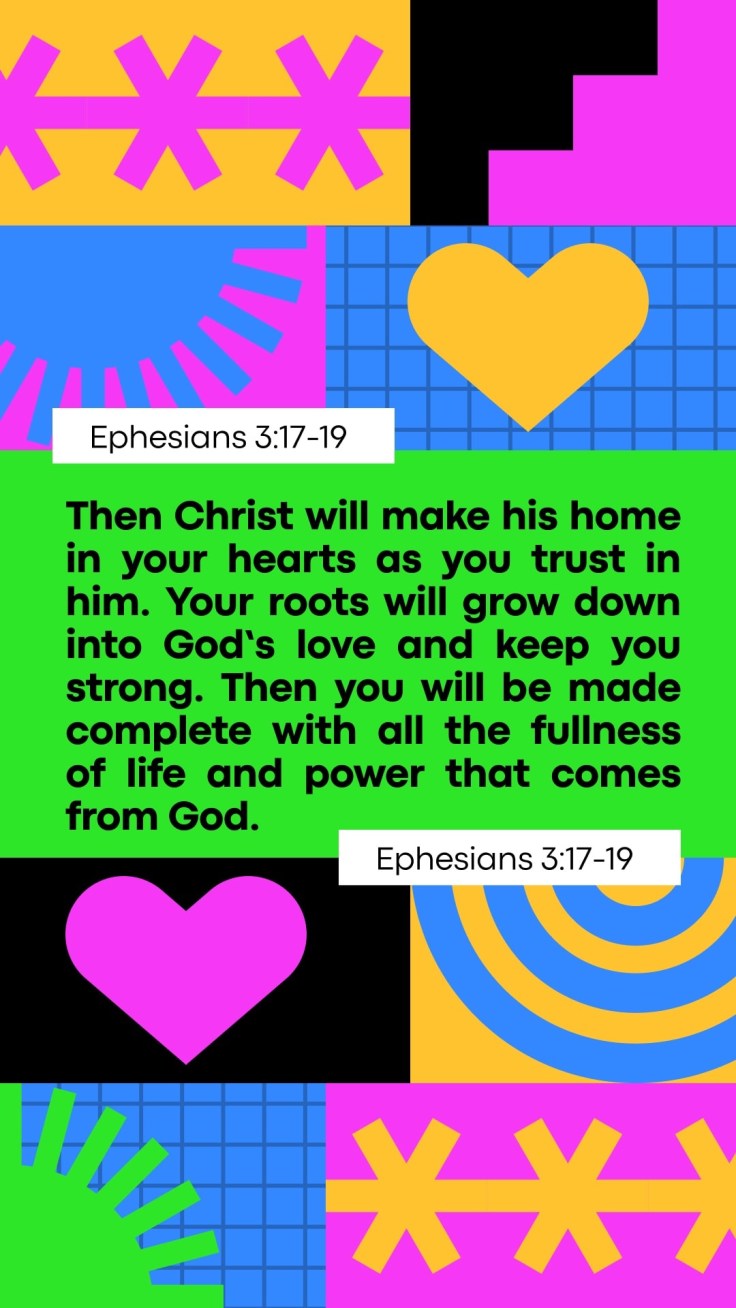 bible.com/bible/1/eph.3.16-20.KJV


 bible.com/bible/1/jhn.7.37-39.KJV
 www.bible.com/en/reading-plans/21718
 bible.com/bible/1/isa.43.25.KJV
 bible.com/bible/1/psa.103.12.KJV
 www.bible.com/en/reading-plans/21718
 bible.com/bible/1/col.2.13-14.KJV

 bible.com/bible/1/1jn.1.6-8.KJV
 bible.com/bible/1/psa.66.18.KJV
 bible.com/bible/1/1jn.1.9.KJV
 bible.com/bible/1/psa.32.3-5.KJV
 bible.com/bible/1/col.2.6.KJV
 bible.com/bible/1/col.2.6.KJV

 bible.com/bible/1/heb.13.5.KJV


 Food for the Soul