
This is What God Does: Isaiah 41:13

My site is for uplifting and encouraging those that need spiritual advice and guidance.
Verse
Psalm 94:19 ESVIn the multitude of my thoughts within me your comforts delight my soul.
Devotion
In the multitude of my thoughts within me thy comforts delight my soul
Psalm 94:19 KJVWhat has been filling your thoughts and occupying your mind in recent days? Perhaps a loved one who is sick, an employer who is difficult, an injustice that you have observed, a longing that you have, or a sorrow that you feel? Or maybe all of the above.
In spite of my many tangled, confused, and anxious thoughts — the psalmist says to the Lord — your comforts fill my soul with joy. Although he describes the onslaught of anxious cares as a “multitude,” he insists that the comforts that God has provided far outweigh and exceedingly outnumber the stresses of life.
In fact the psalmist expresses that the encouragement that God has provided in his Word is so intensive and so uplifting that he has been led, not only to be consoled, but to be delighted. This speaks of a transcending comfort that is powerful and substantial enough to reverse the very trend of the mind toward worry or fear.
Have you experienced the soul-delighting comforts of God’s Word as of late? Has your tendency to worry or fret or grieve been overruled to such an extent that the inertia of your thoughts is now toward joy and peace and satisfaction?
When one looks at the love and faithfulness of the cross, at the wisdom and majesty of creation, at the sweetness and surety of God’s promises, the anxiousness of life is overwhelmed by the comforts for the soul.
Verse
Acts 8:4 ESVThose who were scattered went about preaching the word.
Devotion
They that were scattered abroad went every where preaching the word
Acts 8:4 KJV“They” refers in this verse to the “every home” and “men and women” that the previous verse tells us were being persecuted for their Christian faith and were being committed to prison (8:3). The word here translated “preaching” is not the same word for heralding (public ministry) that is used of Philip’s preaching in the next verse (8:5) — it simply means “to evangelize”, to be good-news messengers.
So the inspired historian’s account of the great dispersion of the gospel throughout the world, beginning with the Samaritans, includes the following crucial ingredients: every one, from every home, evangelizing every where.
Finally, the word for “scattered” is the same word used by Jesus in the parable of the sower to describe the dispersion of seed. Whether you are a man or woman, boy or girl, husband or wife, child or adult – when you think of your situation in life, do you think of yourself as having just “landed” there, or as having been sown there, like seed, for a purpose?
Are you capable enough, knowledgeable enough to evangelize and to teach on your own? If you were, like these saints, scattered away from family and church members would you be ready to evangelize wherever you went, by yourself?
The truth is that there are some unique opportunities already where you alone can witness, even without being chased away from your home or family or friends. You have a unique position in the world, whether it is in the barracks, the dorm room, the home, or the office. You have been planted there for a purpose. Will you bring forth fruit?

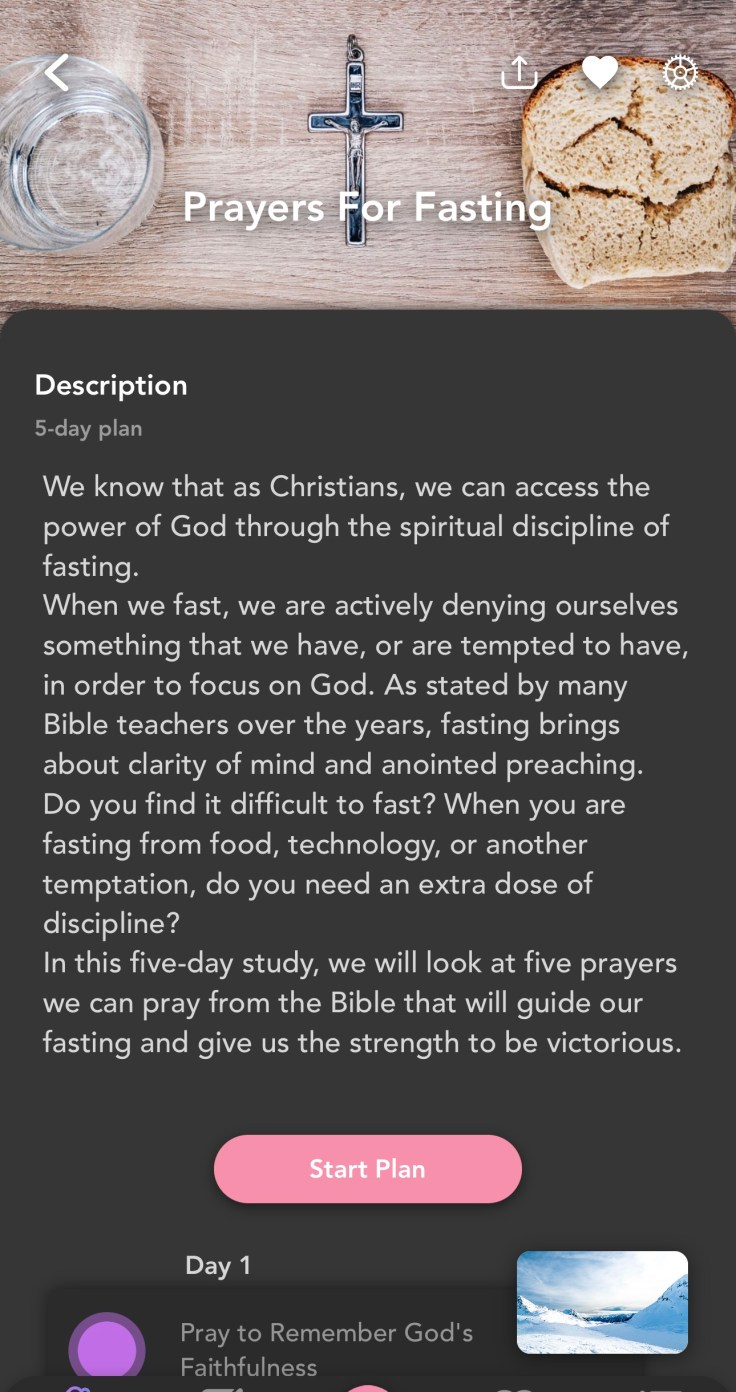
dailydevotion.app/plans/prayers-for-fasting/id70001
Click on the link above and download this beautiful app, or download it from the play store, or from the App Store on your mobile device. God bless you.

This NASB Strong’s utilizes the 1995 version of the NASB text.
A modern revision of the American Standard Version of 1901, which is still respected for its accuracy, the New American Standard Bible (NASB) conforms closely to the original Greek and Hebrew but keeps the reader in mind when it comes to readability. The NASB has enjoyed wide use and honor since it first entered the public in 1971.
The popular Strong’s Exhaustive Concordance contains all of the Bible’s meaningful, significant words and their Greek/Hebrew counterparts. James Strong, who saw his mission as making the language of God available to Bible students, published the first edition of his concordance in 1890—without the aid of modern technology. His work, which lasted 35 years, abides to this day as a universal and central tool for studying the Bible.
The Olive Tree Bible App makes using this tool especially easy and fruitful. Tapping or clicking on a word or Strong’s number in the text displays the dictionary information. If you desire to read the text without the visual interference of the Strong’s numbers, you can toggle the numbers off and back on again at will. Because a number represents the underlying Greek or Hebrew word, your search will show you literally every occurrence of that particular word in the Bible, regardless of the form of the word whose number you tapped. This powerful search process gives you the virtual equivalent of the Englishman’s Greek and Hebrew Concordances and of Young’s Analytical Concordance with your NASB.Upgrade Pricing Available! If you’ve previously purchased the NASB 1995 edition or any Olive Tree collection or bundle that contains the NASB 1995 edition, you can purchase this item for a special upgrade price. The upgrade price will be visible when you log in to your Olive Tree account and add the item to your cart (NOTE: Upgrade pricing is not available via in-app purchase).



Enhance your preaching, teaching and studying with the discounted commentaries below.
New American Commentary
The New American Commentary consistently supports the inerrancy of Scripture and contributing scholars all hold explicit commitments to Scripture’s infallibility. Its distinctive perspective is a focus on the theological ideas springing from Scripture. Along with the textual grounding of an expository commentary, the New American Commentary also focuses on the broader strokes of theology developed by each book, and interprets each book as a theological unity. Rooted in conservative theology, the New American Commentary also directly engages a wide range of theological and exegetical issues raised by contemporary biblical scholarship.
BE Series
This set brings the BE Series commentaries together with all the life-changing truth of the Scriptures combined with the personal wisdom of one of America’s best-known Bible teachers, Dr. Warren W. Wiersbe.
Let one of the most beloved and respected Bible teachers of our time, who has given his life to a deep examination of the Word of God, guide you verse-by-verse through the Scriptures. The BE Series commentary set is a trusted reference you’ll love to read.
All the Bible Series
All The Bible is an 8-volume basic biblical survey series that nurtures a better understanding of the message and background of the biblical writings. R. Alan Culpepper, Dean of the McAfee School of Theology, Mercer University, Atlanta, Georgia is the general editor of the series.
Halley’s Bible Handbook, Deluxe Edition
Halley’s Bible Handbook makes the Bible’s wisdom and message accessible to everyone. Whether you’ve read the Bible many times or never before, you will find insights that give you a firm grasp of God’s Word and an appreciation for the cultural, religious, and geographic settings in which the story of the Bible unfolds. Written for both mind and heart, this 25th edition retains Dr. Halley’s highly personal style.
Save on Commentaries!
New American Commentary (42 Vols.)
BE Series (50 Vols.)
All the Bible Series (8 Vols.)
Halley’s Bible Handbook, Deluxe Edition






In Christ’s Words from the Cross, Charles Spurgeon talks in great lengths about Jesus’ crucifixion, including those who were crucified with him. The dying thief did the impossible that day. In front of multitudes of scoffers, he used the only part of his body not nailed to the cross (his tongue) to proclaim Jesus’ identity: the Messiah. The following is an excerpt from Spurgeon’s message.
THE FAITH OF A DYING THIEF
The story of the salvation of the dying thief is a standing instance of the power of Christ to save, and of His abundant willingness to receive all that come to Him, in whatever plight they might be. I cannot regard this act of grace as a solitary instance, any more than the salvation of Zacchaeus, the restoration of Peter, or the call of Saul, the persecutor. Every conversion is, in a sense, singular: no two are exactly alike, and yet any one conversion is a type of others. The case of the dying thief is much more similar to our conversion than it is dissimilar; in point of fact, his case may be regarded as typical, rather than as an extraordinary incident.
Remember that our Lord Jesus, at the time He saved this malefactor, was at His lowest. His glory had been ebbing out in Gethsemane, and before Caiaphas, and Herod, and Pilate; but it had now reached the utmost low-water mark. Stripped of His garments, and nailed to the cross, our Lord was mocked by a ribald crowd, and was dying in agony: then was He “numbered with the transgressors,” and made as the offscour-ing of all things.
Yet, while in that condition, He achieved this marvelous deed of grace.
Behold the wonder wrought by the Savior when emptied of all His glory, and hanged up a spectacle of shame upon the brink of death! How certain is it that He can do great wonders of mercy now, seeing that He has returned unto His glory, and sitteth upon the throne of light!
“He is able to save them to the uttermost that come unto God by him, seeing he ever liveth to make intercession for them.”
If a dying Savior saved the thief, my argument is that He can do even more now that He lives and reigns. All power is given unto Him in heaven and in earth; can anything at this present time surpass the power of His grace?
It is not only the weakness of our Lord which makes the salvation of the penitent thief memorable; it is the fact that the dying malefactor saw it before his very eyes. Can you put yourself into his place, and suppose yourself to be looking upon One who hangs in agony upon a cross? Could you readily believe Him to be the Lord of glory, who would soon come to His kingdom? That was no mean faith which, at such a moment, could believe in Jesus as Lord and King.
If the apostle Paul were here,
and wanted to add a New Testament chapter to the eleventh of Hebrews, he might certainly commence his instances of remarkable faith with this thief, who believed in a crucified, derided, and dying Christ, and cried to Him as to One whose kingdom would surely come. The thief’s faith was the more remarkable because he was himself in great pain and bound to die.
It is not easy to exercise confidence when you are tortured with deadly anguish. Our own rest of mind has at times been greatly hindered by pain of body. When we are the subjects of acute suffering it is not easy to exhibit that faith which we fancy we possess at other times. This man, suffering as he did, and seeing the Savior in so sad a state, nevertheless believed unto life eternal. Herein was such faith as is seldom seen.
Recollect, also, that He was surrounded by scoffers.
It is easy to swim with the current, and hard to go against the stream. This man heard the priests in their pride ridicule the Lord, and the great multitude of the common people, with one consent, joined in the scorning; his comrade caught the spirit of the hour and mocked also, and perhaps he did the same for a while; but through the grace of God he was changed, and believed in the Lord Jesus in the teeth of all the scorn.
His faith was not affected by his surroundings; but he, dying thief as he was, made sure his confidence. Like a jutting rock, standing out in the midst of a torrent, he declared the innocence of the Christ whom others blasphemed. His faith is worthy of our imitation in its fruits.
He had no member that was free except his tongue, and he used that member wisely to rebuke his brother malefactor and defend his Lord.
His faith brought forth a brave testimony and a bold confession.
I am not going to praise the thief, or his faith, but to extol the glory of that grace divine which gave the thief such faith, and then freely saved him by its means. I am anxious to show how glorious is the Savior–that Savior to the uttermost, who, at such a time, could save such a man, and give him so great a faith, and so perfectly and speedily prepare him for eternal bliss. Behold the power of that divine Spirit who could produce such faith on soil so unlikely, and in a climate so unpropitious.
Thank you for meditating on this teaching from Spurgeon with us.
Christ’s Words from the Cross


I just leveled up my Easter Challenge Badge! Join me and get yours. #youversion #levelup #growth
Click on the link above to watch the story of the day. God bless you.

 www.bible.com/reading-plans/36377/day/6
Click on the link above to start this Bible Reading Plan May the Word of the Lord touch your heart and soul. God bless you.
Click on the link above to watch this video. God bless you.

 www.olivetree.com/votd/index.php


















 bible.com/bible/1/isa.53.5.KJV


 bible.com/bible/1/isa.53.5.KJV

 Food for the Soul