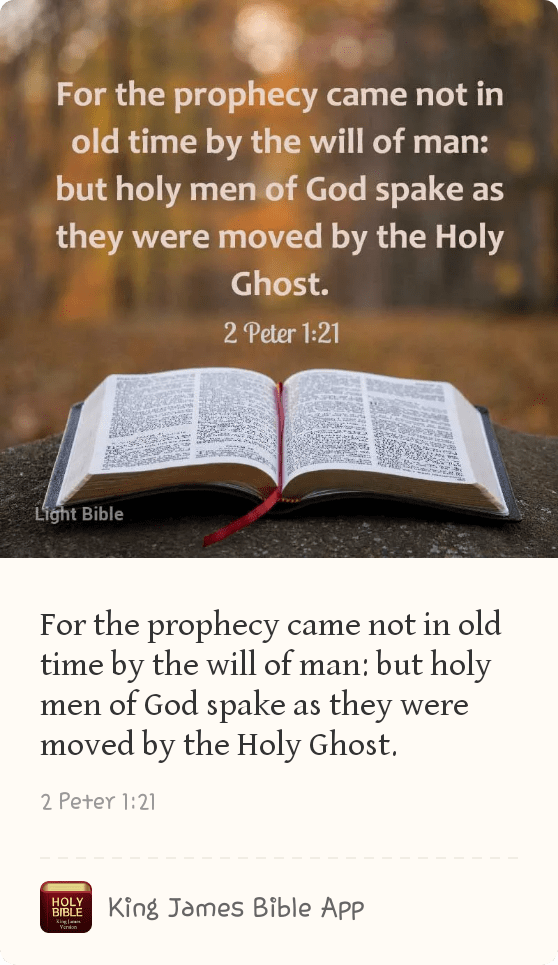
Morning Prayer: 2 Peter 1:21

My site is for uplifting and encouraging those that need spiritual advice and guidance.


Jesus saith unto him, I am the way, the truth, and the life: no man cometh unto the Father, but by me. John 14:6 KJV https://bible.com/bible/1/jhn.14.6.KJV

I finished the Forgiving What You Can’t Forget: A 5-Day Challenge Bible reading plan from @YouVersion! Check it out here: http://bible.com/r/5t5


And as Jesus passed by, he saw a man which was blind from his birth. And his disciples asked him, saying, Master, who did sin, this man, or his parents, that he was born blind? Jesus answered, Neither hath this man sinned, nor his parents: but that the works of God should be made manifest in him. I must work the works of him that sent me, while it is day: the night cometh, when no man can work. As long as I am in the world, I am the light of the world. When he had thus spoken, he spat on the ground, and made clay of the spittle, and he anointed the eyes of the blind man with the clay, and said unto him, Go, wash in the pool of Siloam, (which is by interpretation, Sent.) He went his way therefore, and washed, and came seeing. The neighbours therefore, and they which before had seen him that he was blind, said, Is not this he that sat and begged? Some said, This is he: others said, He is like him: but he said, I am he. Therefore said they unto him, How were thine eyes opened? He answered and said, A man that is called Jesus made clay, and anointed mine eyes, and said unto me, Go to the pool of Siloam, and wash: and I went and washed, and I received sight. John 9:1-11 KJV https://bible.com/bible/1/jhn.9.1-11.KJV

After this there was a feast of the Jews; and Jesus went up to Jerusalem. Now there is at Jerusalem by the sheep market a pool, which is called in the Hebrew tongue Bethesda, having five porches. In these lay a great multitude of impotent folk, of blind, halt, withered, waiting for the moving of the water. For an angel went down at a certain season into the pool, and troubled the water: whosoever then first after the troubling of the water stepped in was made whole of whatsoever disease he had. And a certain man was there, which had an infirmity thirty and eight years. When Jesus saw him lie, and knew that he had been now a long time in that case, he saith unto him, Wilt thou be made whole? The impotent man answered him, Sir, I have no man, when the water is troubled, to put me into the pool: but while I am coming, another steppeth down before me. Jesus saith unto him, Rise, take up thy bed, and walk. And immediately the man was made whole, and took up his bed, and walked: and on the same day was the sabbath. The Jews therefore said unto him that was cured, It is the sabbath day: it is not lawful for thee to carry thy bed. He answered them, He that made me whole, the same said unto me, Take up thy bed, and walk. Then asked they him, What man is that which said unto thee, Take up thy bed, and walk? And he that was healed wist not who it was: for Jesus had conveyed himself away, a multitude being in that place. Afterward Jesus findeth him in the temple, and said unto him, Behold, thou art made whole: sin no more, lest a worse thing come unto thee. The man departed, and told the Jews that it was Jesus, which had made him whole. John 5:1-15 KJV https://bible.com/bible/1/jhn.5.1-15.KJV


DAY FIVE A New Way to Walk and a New Way to See VERSES: John 5:1-15; John 9:1-11 I realize after the past few days you may be saying, “All of this sounds good, Lysa. But my heart is still hurting and the person who hurt me has never even said they’re sorry.” I get it. Healing can feel impossible when there has been no resolution with those who have hurt us. We want them to admit they were wrong. To make things right. To at least apologize. But I’m learning that our ability to heal cannot depend on anyone’s choices but our own. The first time I became aware of this truth was during a trip to the Holy Land when my guide taught about the only two healing miracles Jesus performed in Jerusalem mentioned in the book of John. The first was a healing at the pools of Bethesda. In John 5, we read about a lame man who thought he needed the cooperation of other people to help him get to the water when the angels stirred it, according to the superstition believed by many. So, when Jesus came and asked him if he wanted to be healed, the man’s response was surprising. He gave Jesus an excuse based on the fact that no one would help him into the water. Isn’t it amazing that the man was so focused on what others needed to do that he almost missed what Jesus could do? Without one word about the other people, Jesus instructed him to get up, pick up his mat and walk. The Bible then says, “At once the man was cured” (John 5:9). The healing didn’t involve anyone but the paralyzed man and Jesus. The other healing miracle is found in John 9 with a blind man. In this story, we find the disciples wanting to know whose actions caused this man’s blindness. But Jesus blew their assumptions apart. He didn’t place blame or shame on anyone. He said this man’s blindness “happened so that the works of God might be displayed in him” (John 9:3). Jesus then spat onto the ground, mixed up some mud, rubbed it onto the blind man’s eyes, instructing him to go and wash in the pool of Siloam. Notice that Jesus didn’t make healing contingent on other people doing or owning anything. Jesus gave the instruction. The blind man obeyed. Jesus healed. The blind man moved forward. My guide in Jerusalem that day said “one of these miracles showed us a new way to walk and the other showed us a new way to see.” I couldn’t grab my journal to record this revelation fast enough. I wrote, “For me to move forward, for me to see beyond this current darkness, is between me and the Lord. I don’t need to wait on others to do anything. I must simply obey what God is asking of me right now. God has given me a new way to walk. And God has given me a new way to see. It’s forgiveness. And it is beautiful.” Our ability to heal cannot depend on others wanting our forgiveness, but only on our willingness to give it. Our ability to heal also cannot depend on them receiving adequate consequences for their disobedience, but only on our obedience to trust God’s justice whether we ever see it or not. My healing is my choice. And your healing? It’s with the utmost compassion that I say your healing is your choice too. We can heal. We can forgive. We can trust God. And none of those beautiful realities can be held hostage by another person. RESPOND: Have you ever found yourself stuck in a place of believing that your ability to heal is dependent on other people and their choices? Spend some time in prayer today surrendering every hurt and even releasing those who have hurt you to Jesus. Ask Him to help you believe He truly is able to heal you… to make your soul well. You deserve to stop suffering because of what other people have done to you. Walk through a step-by-step process to free yourself from the hurt of your past and feel less offended today with the help of Lysa TerKeurst’s newest book, Forgiving What You Can’t Forget. Find out more at ForgivingWhatYouCantForget.com .


I just finished day 4 of the @YouVersion plan ‘Forgiving What You Can’t Forget: A 5-Day Challenge’. Check it out here: http://bible.com/r/5t5

And Adam knew Eve his wife; and she conceived, and bare Cain, and said, I have gotten a man from the LORD. And she again bare his brother Abel. And Abel was a keeper of sheep, but Cain was a tiller of the ground. And in process of time it came to pass, that Cain brought of the fruit of the ground an offering unto the LORD. And Abel, he also brought of the firstlings of his flock and of the fat thereof. And the LORD had respect unto Abel and to his offering: but unto Cain and to his offering he had not respect. And Cain was very wroth, and his countenance fell. And the LORD said unto Cain, Why art thou wroth? and why is thy countenance fallen? If thou doest well, shalt thou not be accepted? and if thou doest not well, sin lieth at the door. And unto thee shall be his desire, and thou shalt rule over him. And Cain talked with Abel his brother: and it came to pass, when they were in the field, that Cain rose up against Abel his brother, and slew him. Genesis 4:1-8 KJV https://bible.com/bible/1/gen.4.1-8.KJV


Be ye angry, and sin not: let not the sun go down upon your wrath: neither give place to the devil. Ephesians 4:26-27 KJV https://bible.com/bible/1/eph.4.26-27.KJV

DAY FOUR About My Anger VERSES: Ephesians 4:26-27; Genesis 4:1-8 Even when we prepare our hearts in advance like we discussed yesterday, there will be times when we reach the end of the day and we just can’t shake how hurt we are. In the past, this is when I would turn to and, unfortunately, misuse Ephesians 4:26-27. It was so convenient to pull that passage out when someone wanted to go to bed and I still wanted to talk about whatever was causing a conflict. “Oh no, you can’t call timeout right now. We have to keep talking because the Bible clearly says, ‘do not let the sun go down on your anger.’” But I noticed recently the first three words say, “in your anger.” So, it isn’t about resolving all relational issues before 9:00 p.m. It’s talking about my anger, not our frustration. It’s like the writer of Ephesians, Paul, is saying “You’ve got to deal with this anger. Don’t lay in your bed and let it consume your mind. If it does, it will come out of your mouth and reveal who or what is mastering you.” When I looked for the very first time “anger” is mentioned in the Bible, I found myself in Genesis 4:2-8 where we encounter the first relational conflict in Scripture in the story of Cain and Abel. I’ve known the story of these two brothers for years, but I missed a really important detail. In between Cain getting angry about God not accepting his offering and killing his brother, the Lord came and talked with him. The Lord, Himself, said to Cain, “Why are you angry? Why is your face downcast? If you do what is right, will you not be accepted? But if you do not do what is right, sin is crouching at your door; it desires to have you, but you must rule over it.” (Genesis 4:6-7) And suddenly it’s not so much a story about Cain and Abel; God is speaking to me. He’s showing me that what I let consume my mind, makes it way out through my mouth, revealing the real source of what’s driving my decisions. Here’s where we see this in the story of Cain and Abel: Mind: Cain refused to humble himself and allowed this anger to fester inside him. Mouth: Cain was not willing to let forgiveness spill from his lips. What ruled him: The sin that was crouching at his door deeply ruled over him, so much that he killed his brother. He gave his feelings the right to dictate his actions, even after God came and talked with him. What a powerful reminder to not let anger and frustration run rampant through my thoughts. It’s hard when the hurt is so fresh or the frustration is so ongoing. But isn’t God so gracious that He gives us these verses in Ephesians and ties this lesson to something we get to see every night? As the sun is going down, we can remember it’s time to pause and let God tend to any strong or potentially damaging reactions to hurts that could consume us. We can pray, “Father I need Your forgiveness to flow to me and through me right now so Your Spirit can work in me and sweep my heart clean.” This doesn’t make light of or deny our hurt; it puts it in the hands of God so He can help us better process it. RESPOND: While most people would never go as far as Cain did, what could be some of the devastating outcomes of refusing to allow God to address our feelings of anger and unforgiveness? What are some healthy ways you can process the strong emotions that get stirred up when you’re hurt?


After this manner therefore pray ye: Our Father which art in heaven, Hallowed be thy name. Thy kingdom come. Thy will be done in earth, as it is in heaven. Give us this day our daily bread. And forgive us our debts, as we forgive our debtors. And lead us not into temptation, but deliver us from evil: For thine is the kingdom, and the power, and the glory, for ever. Amen. For if ye forgive men their trespasses, your heavenly Father will also forgive you: but if ye forgive not men their trespasses, neither will your Father forgive your trespasses. Matthew 6:9-15 KJV https://bible.com/bible/1/mat.6.9-15.KJV

DAY THREE The Daily Cure for a Heavy Heart VERSES: Matthew 6:9-15 Did you know that Jesus has given us the perfect prayer to pray each day to help us get ahead of any offenses that may be coming our way? In Matthew 6, we read about Jesus teaching the disciples how to pray, more commonly known as the Lord’s Prayer. And today I want us to note the very parts Jesus seems to emphasize the most—confession and forgiveness. If you haven’t already done so, take a few moments to read Matthew 6:9–15. Giving and receiving forgiveness makes up almost half of what Jesus teaches here. Wow! This grabs my attention and makes me lean in a little more to what Jesus wanted us to do on a daily basis besides just making our prayers about requesting help and provision from God. The Lord’s Prayer reminds us what the human heart needs every day—we need God, we need to be forgiven, and we need to forgive. Which means forgiveness is supposed to be as much a part of our daily lives as eating and sleeping. But I will readily admit, I’m not even sure I’ve ever done this weekly, much less daily. And maybe that’s the very reason I often have an unexplainable heavy feeling inside of me. I’m too easily offended. I’m too quick to get defensive. I’m too slow to turn to prayer. I’m very rarely confessing. And I’m too often not forgiving. But I want to change this. I want to mature in this. I know I won’t do this perfectly. But that doesn’t mean I don’t try it at all. Just a few weeks ago, someone I’ve been trying to help completely blindsided me with a reaction that felt extremely out of character and honestly undeserved. I was hurt. All I wanted to do was pull back from helping and give way to a full unleashing of my hurt on her. But instead of immediately reacting, I remembered how earlier that morning I had prayed the Lord’s Prayer and confessed several things to the Lord in which my own heart needed some work. I’d pre-decided to forgive those who might do or say something that might hurt me or stir up my strong emotion that day. Instead of letting my anger stir me to cause more hurt and pain, I simply let my anger inform me that something needed to be settled between my friend and me. I asked her if she could come over to my house and instead of us trying to figure it out or talk it out, maybe we could pray it through together. I let Jesus in me talk to Jesus in her. As we prayed, the most unexplainable peace washed over us both. It didn’t necessarily solve the issue at hand. But it did prevent the chaos of adding in more hurt, confusion, and opportunities for resentment. Confession breaks the cycle of chaos inside of me. Forgiveness breaks the cycle of chaos between us. The Lord’s Prayer prepared my heart for something I didn’t even know was coming later that day. Oh, friend… believe me when I say, the best time to forgive is before we are ever offended. The next best time to forgive is right now. RESPOND: Were you surprised to see that confession and forgiveness should be a part of our daily lives? How often do these two practices show up in your own life? Knowing there is no condemnation if it has been a while, start today. Spend time purposefully sweeping your heart clean with confession and forgiveness.


I just finished day 2 of the @YouVersion plan ‘Forgiving What You Can’t Forget: A 5-Day Challenge’. Check it out here: http://bible.com/r/5t5



Put on the whole armour of God, that ye may be able to stand against the wiles of the devil. For we wrestle not against flesh and blood, but against principalities, against powers, against the rulers of the darkness of this world, against spiritual wickedness in high places. Ephesians 6:11-12 KJV https://bible.com/bible/1/eph.6.11-12.KJV


casting all your care upon him; for he careth for you. 1 Peter 5:7 KJV https://bible.com/bible/1/1pe.5.7.KJV

Dearly beloved, avenge not yourselves, but rather give place unto wrath: for it is written, Vengeance is mine; I will repay, saith the Lord. Therefore if thine enemy hunger, feed him; if he thirst, give him drink: for in so doing thou shalt heap coals of fire on his head. Be not overcome of evil, but overcome evil with good. Romans 12:19-21 KJV https://bible.com/bible/1/rom.12.19-21.KJV


DAY TWO When Unchangeable Feels Unforgivable VERSES: Romans 12:19–21, 1 Peter 5:7, Ephesians 6:11–12 Unchangeable can feel unforgivable. When someone takes something you will never get back. When the outcome seems so final you can’t get your bearings for how to go on. When they hurt you so deeply you fear you’ll never feel normal again. With a grief that’s so consuming from all these painful situations, it’s completely maddening to think forgiveness should apply here. What would forgiveness even accomplish? I understand this question. I’ve wrestled with it myself. And while I will be the first in line to raise my hand and admit forgiveness is a hard step to take, it’s also the only step that leads to anything good. Every other choice—including the choice to not do anything and remain where we are—just adds more hurt upon hurt. Here are a few truths I’ve been learning to hang on to in my heart when I’m struggling to step toward forgiveness. 1. Forgiveness is more satisfying than revenge. (Romans 12:19–21) Revenge is you paying twice for a hurt that someone else did to you. You may think it will make you feel better in the short term, but in the long term it will always cost you more emotionally and spiritually than you’d ever want to pay. The only thing your revenge will do is add your wrongdoing on top of theirs. Forgiveness doesn’t let the other person off the hook. It actually places them in God’s hands. And then, as you walk through the forgiveness process, it softens your heart. The peace from forgiveness is more satisfying then than revenge. 2. Our God is not a do-nothing God. (1 Peter 5:7) I was recently participating in a Q&A session where someone in the audience asked, “How can God just do nothing?” The pain in her question was deep. Gracious, do I ever understand what that feels like. When you are suffering so much that each next breath seems excruciating, it’s easy to start assuming God is doing nothing. But we don’t serve a do-nothing God. He is always working. It may be a slow working miracle. It may look different than what we expect. But God loves us, and He is always doing something. 3. The enemy is the real villain. (Ephesians 6:11–12) Yes, people do have a choice to sin against us or not. And certainly, when we are hurt, the person hurting us may have willingly played into the enemy’s plan. But it helps me to remember that this person isn’t my real enemy. The devil is real and on an all-out assault against all things good. He hates the word “together.” And he especially works with great intentionality against anything that brings honor and glory to God. Oh, friend, the heartbreaks you carry are enormous. And your desire to undo some of what has been done is so very understandable. It’s okay to carry both the desire to want things to change and an acceptance that on this side of eternity they won’t change. You can carry both. You can honor both. Adding truth into our perspective makes even the unchangeable, forgivable. None of this is simple. These aren’t truths to simply read through, but sit with. And sit in. Until we can dare to walk in it. Live it out. And maybe even one day declare it as a truth we’ve decided to own. RESPOND: Look back at the three points about forgiveness. Which one did you need the most? Write out the verse that goes with that point and spend some time both meditating on it and memorizing it this week.



I just finished day 1 of the @YouVersion plan ‘Forgiving What You Can’t Forget: A 5-Day Challenge’. Check it out here: http://bible.com/r/5t5


and be ye kind one to another, tenderhearted, forgiving one another, even as God for Christ’s sake hath forgiven you. Ephesians 4:32 KJV https://bible.com/bible/1/eph.4.32.KJV

DAY ONE Forgiveness: The Double-Edged Word VERSE: Ephesians 4:32 Do you ever find yourself defining life by before and after the deep hurt? The horrific season. The conversation that stunned you. The shocking day of discovery. The divorce. The wrongful death so unfathomable you still can’t believe they are gone. The breakup. The day your friend walked away. The hateful conversation. The remark that seems to now be branded on your soul. The day everything changed. That marked moment in time. Life before. Life now. Is it even possible to move on from something like this? Is it even possible to create a life that’s beautiful again? I deeply understand this kind of defining devastation in such a personal way. When your heart has been shattered and reshaped into something that doesn’t quite feel normal inside your own chest yet, the word forgiveness feels a bit unrealistic to bring into the conversation. But can I whisper something I’m learning? Forgiveness is possible, but it won’t always feel possible. It’s a double-edged word, isn’t it? It’s hard to give. It’s amazing to get. But when we receive it so freely from the Lord and refuse to give it, something heavy starts to form in our souls. It’s the weight of forgiveness that wasn’t allowed to pass through. And for me, that’s mainly because I’ve misunderstood something so incredibly profound about forgiveness. Forgiveness isn’t something hard we have the option to do or not do. Forgiveness is something hard-won that we have the opportunity to participate in. When I wrongly think forgiveness rises and falls based on all my efforts, conjured maturity, bossed-around resistance, and gentle feelings that feel real one moment and fake the next, I’ll never be able to authentically give the kind of forgiveness Jesus has given me. My ability to forgive others is made possible when I lean into what Jesus has already done, which allows His grace for me to flow freely through me (Ephesians 4:7). Forgiveness isn’t an act of my determination. Forgiveness is only made possible by my cooperation. Cooperation is what I’ve been missing. Cooperation with what Jesus has already done makes verses like Ephesians 4:32 possible. “Be kind to one another, tenderhearted, forgiving one another, as God in Christ forgave you.” Forgiving one another just as Christ forgave you. God knew we couldn’t do it on our own. So, He made a way not dependent on our strength. A forgiving way. A way to grab on to Jesus’ outstretched arms, bloody from crucifixion and dripping with redemption. He forgives what we could never be good enough to make right. And makes a way for us to simply cooperate with His work of forgiveness…for us to receive and for us to give. That person or people—they’ve caused enough pain for you, for me, and for those around us. There’s been enough damage done. And you don’t have to be held hostage by the pain. You get to decide how you’ll move forward. If you’re knee-deep in pain and resonate with the feelings of resistance I have felt too, let me assure you over these next few days: forgiveness is possible. And it is good. RESPOND: What is your initial gut reaction to the word “forgiveness”? How does it encourage you to know that forgiveness is made possible by our cooperation instead of our determination? Spend some time journaling about this today. Invite God into your questions and your hesitations.


The right prayer for the right occasion is as close as your smartphone or tablet with Prayers of the Early Church. Starting with the Biblical prayers of Jesus, Mary, Stephen, Paul, and Peter, along with other prayers adapted from Scripture, this collection also brings you a selection of rich and fruitful prayers of the early church. Included are prayers from church liturgy along with contributions from familiar names such as Clement of Rome, Polycarp, Ignatius, and Augustine. Although the prayers are arranged according to the century they were written, the index at the end is a powerful tool to find just the right prayer for the moment, with topics such as blessing, growth in grace, illumination, forgiveness, thanksgiving, and more. Be sure to bookmark and tag your favorites, as you can return to them again and again for inspiration in your prayer life. Get a Copy! Free offer ends May 9, 2022. Click below to get a copy today! Prayers of the Early Church
You can get this amazing gift when you download the Olive Tree App. There are lots of free things in the Olive Tree App. They are always giving something away, and there are in app purchases at discounted prices. Download the app and experience what’s there. I wanted to share this with you all. I wanted to share this blessing with you all. God bless, stay safe, and have a wonderful evening.



For God sent not his Son into the world to condemn the world; but that the world through him might be saved. John 3:17 KJV https://bible.com/bible/1/jhn.3.17.KJV

https://music.youtube.com/watch?v=VH6VmXISUCQ&feature=share
To watch this video, click on the link above. I pray it will lift your spirit, and increase your faith in trusting God through His Son, Jesus Christ. God bless you, and stay safe.

Fear of failure can stop you in your tracks, even if you are after something that will bring you joy and excitement. As writer Suzy Kassem says, “Fear kills more dreams than failure ever will.” Fear can cause people to miss out on opportunities that allow them to reach their full potential. By stopping and not reaching your goal, the path remains unclear. Instead of allowing fear to stop you, see fear as forcing you to think about the path forward. Fear is not a roadblock. It can be used to clarify the path. Successful people want to reach their goal more than they fear failing. Here are four steps to help you embrace your fear of failure and get what you want. 1. Identify what you want. When you are overcome with fear, this is the time to pause. Sometimes, fear can overpower your ability to see your goal clearly. You get lost in the emotion and lose sight of your vision. Reflect on what it is that you want. Is your goal to get a raise or a promotion? Or is your goal to speak at a conference, get on a board or be a contributing writer for a media platform? There is a reason why you are told to focus on a motionless point far off in the horizon when you are nauseated. It helps to stabilize the body. Think of fear in a similar way. When you are fearful, focus on your end goal to stabilize yourself. When you can see your goal, you are in a better position to tackle it. Don’t let fear cloud your vision. 2. Realize what is stopping you from reaching what you want. Once you regain your footing and clarity on what you want, own up to what is making you fearful. Are you afraid of criticism? Are you afraid of not being able to be yourself? Are you afraid of competition? What makes you afraid? Understand what is stopping you so that you can overcome it. If you don’t see the hurdle, you can’t jump over it. Embrace the barrier to break free from it. 3. Own your discomfort. Oprah Winfrey says, “Whatever you fear most has no power – it is your fear that has the power.” Don’t let fear weaken you. Do not feel shame in being fearful. Find strength in your fear. It is the key to unlocking your potential. Your fear is your power. Let’s say you want to be more provocative in your writing or with ideas for your team at work, but you fear that not everyone will agree with you. Your opinion is what makes you, you. Your opinion is your power. Own your opinion. Own your power. Diversity of thought is ultimately what moves conversations and projects forward. Capture the energy that you are putting into being afraid, and use it to conquer your fear. Fear can’t hold you down if you don’t let it. 4. Start feeling comfortable with the uncomfortable. To restart your journey towards your goal take a small step. Dip your toe back in. You may feel weary or uncomfortable. Then take another small step. Push yourself out of your comfort zone. For example, your goal is to speak at a well-known conference, but you worry that you are not good enough to be considered. Begin by applying to speak at smaller events. Write down your accomplishments. Seeing what you have done will help you to believe what you can do. Start putting yourself out there and hearing the word “no.” The more you hear “no,” the less afraid of it you will be. And as billionaire entrepreneur Mark Cuban says, “Every ‘no’ gets [you] closer to a ‘yes.’” If you are not feeling slightly uncomfortable, you are not putting yourself out there and not moving towards your goal. If you stay comfortable, you stay put. If you feel comfortable, this is when you should be afraid. It is a sign you are not taking the steps that will help you get closer to your goal. Rethink risk. Risk is no longer the actions you take but rather the actions you choose not to take. The risk is feeling comfortable. How does feeling uncomfortable sound now? Being uncomfortable is the new comfortable. To achieve your goals, see fear as the key to helping you clarify your path forward. Identify your goal, realize what is stopping you from achieving it, feel the discomfort and start getting used to the uncomfortable. Want it more than you fear it.

 Food for the Soul